 It appears that you are currently in United States.
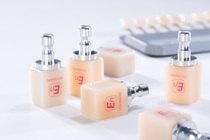
From October 30, 2026, VITA Zahnfabrik will expand the VITA ENAMIC HT range to include seven additional VITA classical A1–D4 shades. This means that the hybrid ceramic featuring the unique PICN (Polymer Infiltrated Ceramic Network) technology will also be available in the shades A1, A2, A3, A3.5, A4, B1 and C1. The new version is available as a monochromatic HT block in the EM-14 geometry (12 x 14 x 18 mm) for the CEREC/inLab system.
Download press release?
You can download this press release and all contained media as a .zip file.One material, two shade systems
This shade expansion means that VITA ENAMIC will now be available in both VITA shade systems: VITA SYSTEM 3D-MASTER and VITA classical A1–D4. Tooth shade reproduction has been simplified, as shade selection and application can be carried out directly within the chosen shade system. The material, indications and processing are unchanged. This expansion applies exclusively to the VITA ENAMIC HT shade range. The T, ST and VITA ENAMIC multiColor variants are still available in VITA SYSTEM 3D-MASTER shades.
PICN Technology for tooth structure preserving treatment concepts
To date, VITA ENAMIC is the first and only commercially available hybrid ceramic that features PICN technology. The dual network structure of VITA ENAMIC combines high strength with natural elasticity and, by absorbing chewing forces, promotes an even distribution of the forces acting on it. The minimum wall thicknesses enable preparation and restoration approaches that preserve tooth structure. This allows more natural tooth structure to be preserved when the indication is appropriate.
For efficient chairside workflows
Restorations can be ground down in less than five minutes, are ready for use immediately after polishing and conditioning and do not require firing. Thanks to the short processing times, VITA ENAMIC supports cost-effective chairside workflows. Compared to lithium disilicate, processing time can be reduced by more than 25%, and compared to zirconia, by more than 30%. This allows the entire workflow from digital scanning to integration, to be completed in a single session in less than 40 minutes. *
* Comparison based on publicly available manufacturer specifications and published reference data (e. g., grinding and firing times); process times derived on a model basis.